Documentation/Building on Supero/Platform vendor lock-in: what you can actually export
Platform vendor lock-in: what you can actually export
Platform vendor lock-in, compared: what Bubble, Retool, Lovable, Bolt, v0, Supabase and Supero each hand you on the way out, and what still calls home.
- objection-handling
- lock-in
- conversion
Overview
**Short answer:** it varies more than the marketing suggests. Bubble hands you your data and no code, by design. Retool git-syncs your apps as Toolscript that only runs in Retool. Lovable, Bolt and v0 give you the code and sync it both ways with GitHub. Supabase gives you Postgres and your own application code. We give you a readable directory of Python and JavaScript, **one-way**, and the running app still calls us for auth, data and logic unless you self-host the platform. The table is below. We are not the best row in it.
(Disclosure: I work on Supero. This page exists because the lock-in question kept coming up in sales calls and deserved a URL rather than a conversation, and because the answer changed recently in our favour and I would rather publish the whole answer than the good half.)
---
Our answer, bad news first
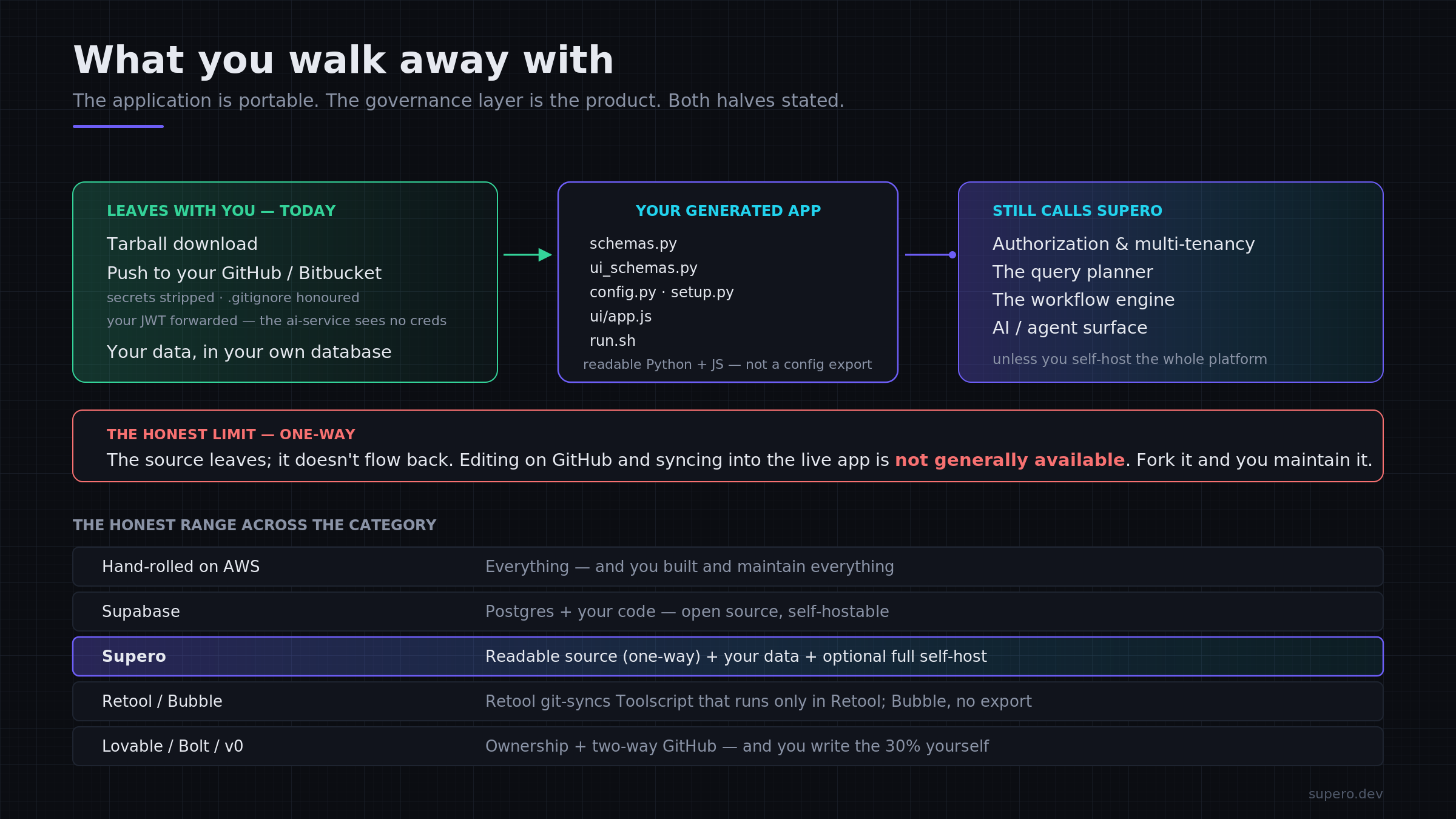
schemas.py, ui_schemas.py, config.py, setup.py, ui/app.js, run.sh.That is what you walk away with — a directory of readable Python and JavaScript your team can open, diff and host. Download it as a tarball today, or push it to a GitHub or Bitbucket repo you own.
One thing to be clear about, because it shapes what the artefact is. Generation is not reproducible. Two runs from the same input measured 0.635 similarity on
ui/app.js, so about 36% of that file moved between them — and that path already requests temperature=0.2, under a router defaulting to 0.0, with no seed pinned anywhere. Low temperature does not make a multi-step generation reproducible. So the tarball is *that run*: a specific directory you can read, diff and host, and not a build you can recreate by generating again.Now the parts most vendors leave out.
**The source leaves; it does not come back.** You cannot edit on GitHub and have changes flow into the live app. An ingestion path exists but is opt-in, gated and deliberately fails closed at every step. Fork it and you have forked it. You maintain it from then on, off-platform.
**The runtime is ours, and that is the real lock-in.** Take the source, host the UI on your own AWS or GCP, and auth, data, logic and AI still call Supero. Those are the platform, not your app's code. Full independence means the on-premise deployment: a Debian package with offline licence validation, built for air-gapped environments. It exists, and it is an Enterprise arrangement. We have not yet published a runbook from a customer who has actually done it, so treat it as documented-and-shipped rather than independently proven.
So: **your application is portable. The governance layer is the product.** If that trade is unacceptable, stop reading. We are not your platform, and I would rather you worked that out here.
| What | Ships today | How |
|---|---|---|
| Download your app's source as a tarball | ✅ | One action. Readable Python + JS. |
| Push to your own GitHub or Bitbucket | ✅ | Secrets stripped, .gitignore honoured. Your JWT is forwarded, and the ai-service never sees a provider credential. |
| Keep your data in your own database | ✅ | Live connector modes copy no column or row data into us. A small identity map retains primary keys, which is what makes a row addressable for update and delete. |
| Run the app off Supero's cloud | ⚠️ | UI on your AWS or GCP; auth, data, logic stay on Supero's backend. |
| Self-host the whole platform | ⚠️ | A Debian package with an offline licence, Enterprise-only. There is no Helm chart and no Kubernetes installer. The on-premise build runs AISVC_RUNTIME_ONLY, which strips the MCP router: it runs your apps, it does not generate new ones. |
| Edit on GitHub and sync back | ❌ | **Not generally available.** One-way. |
---
Vendor lock-in across six platforms, compared
| Platform | What you walk away with |
|---|---|
| **Hand-rolled on AWS** | Everything — and you built and maintain everything. |
| **Supabase** | Postgres plus your own application code. Open source and genuinely self-hostable. The strongest position here. |
| **Lovable / Bolt / v0** | Legal ownership from the first minute and two-way GitHub sync. Bolt zips on any plan; v0 works on branches in your own repo; Lovable gates full download to paid tiers. None is relationship-free; all three usually couple you to Supabase or Vercel. |
| **Supero** | Readable source, **one-way**, plus your data and an optional full self-host. Governance runs on our runtime. |
| **Retool** | Your data, plus apps git-synced to your own repo as Toolscript (Source Control is Enterprise-only), and it only runs inside Retool. |
| **Bubble** | Your data. No code export, by design and by their own documentation. |
We are in the middle, and on the code-access axis specifically the AI builders beat us: their sync is two-way and ours is not. What you buy with that difference is a governance layer you would otherwise write: the isolation model and the field-permission enforcement. If you do not need those, their trade is better than ours and you should take it.
What we are weak on
We are designed for SOC 2 and HIPAA controls and certified for neither, and we are early access with the rough edges that implies. On the governance side: access policy is permissive by default inside a tenant, and we log writes but not reads. Every weakness we know about. On a page about what you can verify, it would be poor form to summarise our own weaknesses and leave you no way to check the summary.
---
The five questions to ask any platform
Portable regardless of what you choose. This is the part of the page worth stealing.
1. **Name the artefact.** What is the file, and have you ever downloaded it? A capability nobody has exercised is a capability nobody has verified. 2. **Where does the data live, and can it live somewhere you control?** 3. **What still calls the vendor after you export?** The question people forget, and the one that determines actual lock-in. 4. **Is there a self-host path, and is it real** — a shipped deployment, with a customer who has done it? 5. **Does the export path get exercised?** An untested export is a claim, not a capability.
I have answered our #4 with more precision than our #5, deliberately. If a vendor, us included, answers #4 with the word "yes" and nothing after it, that is the answer to a different question.
---
Frequently asked questions
Can you export your code from Bubble?
No. Bubble's stated position is that the app exists inside Bubble and does not leave. You can export your data; you cannot export the application.
Can you export apps from Retool?
Retool has Source Control: apps check into GitHub, GitLab, Bitbucket, Azure Repos or CodeCommit as Toolscript. Retool's pricing table lists it under **Enterprise only**, so it is not available to a Business-tier team. The artifact is real and version-controlled, and it runs inside Retool.
Do Lovable, Bolt and v0 give you the code?
Yes, with two-way GitHub sync. Access differs by tier: Bolt provides a zip on any plan, Lovable's full download is paid-only, and v0 works on branches in a repo you own.
Does Supero export code?
Yes. A readable directory of Python and JavaScript, as a tarball or pushed to your own GitHub or Bitbucket. One-way: the source leaves, it does not flow back.
What happens to my app if Supero disappears?
You hold the source. The running app calls our backend for auth, data and logic, so continuity means either the on-premise deployment or rebuilding that layer. That is the honest shape of the risk, and it is why question 3 above matters more than question 1.
Is my data locked in?
No. In live connector modes we query your own database and copy no column or row data into ours.
---
What to do next
**Ask your current vendor the five questions.** That is the useful thing on this page and it costs you nothing.
An export is worth what the thing it exports is worth. **sixteen platform-generated apps are live and need no account.** The full list is at
api.supero.dev/api/v1/public/showcase. All but two are single-tenant public demos, so they show the generated application rather than the governance. If the output is the standard you would ship, request access and download a bundle before you commit to anything. Question 1 applies to us too, and nobody should get a pass on it.Related: Bubble · Retool · Supabase · Lovable, Bolt and v0
---
*Competitor export behaviour checked **September 2026**. This changes; corrections welcome.*
What Supero hands you is not a claim to take on trust: 19 generated apps, full source, MIT, at github.com/supero-platform/supero-apps. That is the artefact this article says to ask every platform for.
On this page